article

how to keep tourism sales moving when an account changes hands

why revenue leaks when travel trade accounts change hands, and a transition system that keeps sales moving.
01

account history only gets you so far.

a ten-month engagement is ending. the consultant who covered an account manager's maternity leave is handing back a portfolio of travel trade accounts, major OTA, wholesaler, and tour operator relationships, and the record of those ten months, pricing decisions, partner history, open negotiations, sits in the CRM, in JIRA, in files across the shared drives, and in email threads. she puts together a slide deck of where each account stands, pulls the most important files alongside it, and four days are set aside to walk the returning account manager through it all.

the trouble starts the week after, when partners start asking the returning account manager questions, or when the returning account manager must start picking up the work on her own. an OTA's or wholesaler's momentum can be slowed or derailed if the context around each action or decision, or the reasoning behind them, didn't make it through the transition.

in this engagement, maintaining sales continuity during the account transition wasn't going to come down to whether the information survived, because it had. the record for each trade partner lived in the company systems; and because other sales teammates and the director of travel trade sales had worked alongside her on some of the accounts, pieces of it lived with them too.

the knowledge was all there. it was just in a lot of different places. the returning account manager could read every file and still be unable to understand why a decision was made or address a specific partner strategy question unless she researched thoroughly. piecing an account back together took time, and that delay could mean slower decisions, stalled deals, and unexpected but preventable mistakes.
02

what happens to account context during a transition.


bookings can slow down in four ways when an account changes hands, and walking through a deck doesn't reliably prevent them.

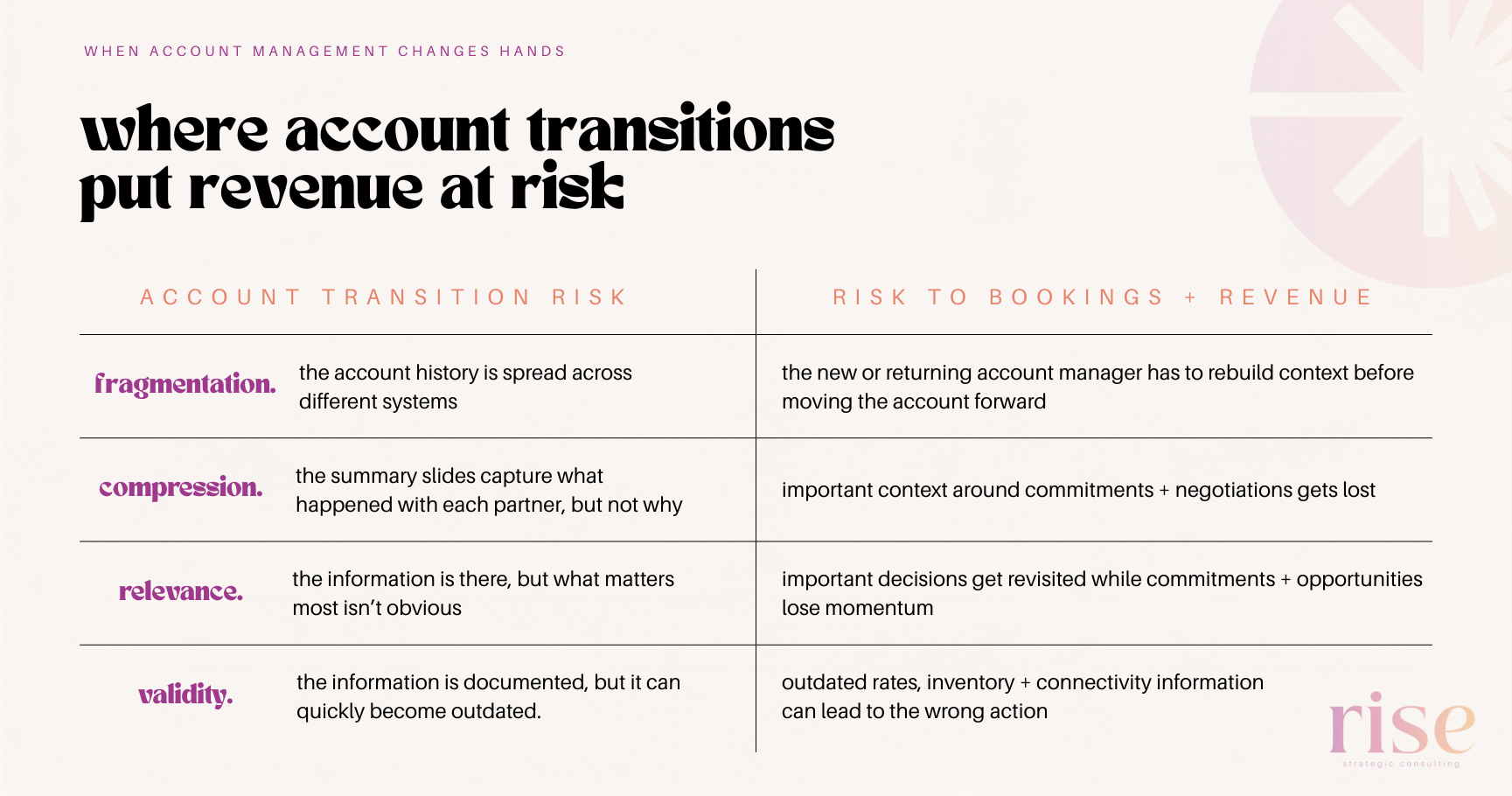
fragmentation
where is the information?

a pricing decision might start in a meeting note, change in an email thread, then move to a ticket and a project board. until the new or returning account manager pieces it together, things slip: an attraction sits off sale because the listing was never switched back on, or a partner can't sell tours + activities because an integration problem went unnoticed.

compression
why was the decision made?

a handover deck might show that a partner kept the old retail price while being allowed to sell at the newer, lower net rate early. what it may not capture is that this was deliberate: a temporary pricing advantage meant to end when the new retail price took effect. without that, the new manager sees the pricing decision but not the strategy behind it.

relevance
what actually matters?

the new or returning account manager can review the CRM, emails + files. the harder part is knowing what matters. one email thread may contain a commitment a trade partner expects to be honored, while a CRM task may explain why an OTA still hasn't reactivated a listing and can't sell the product. search can find the information, but it can't tell her what's important or capture context that wasn't written down.

validity
is it still true?

everything in the handover is current when it is written, but that can change quickly. rates change, partner terms get renegotiated + integrations get fixed. without dates or links to the live system, outdated information can still look current when someone goes back to use it.

where account transitions put revenue at risk
where account transitions put revenue at risk.
03

when missing context starts affecting sales.

each gap can cost revenue. a partner may reopen a rate negotiation + win back ground the last manager had already secured because the new manager doesn’t have the reasoning behind the deal. a seasonal co-op campaign may only partially happen because the returning manager didn’t get the full picture.

the impact may not show up right away. weeks later, sales can come in below where they should, because work slowed while the new or returning account manager got up to speed. that doesn't mean the account was badly documented or that she did anything wrong. there's just a lot of context to absorb when you step into an account someone else has been running.

this isn't unique to one company. SHRM surveyed 1,912 HR professionals in 2025, and only 43% said their organizations document client relationships. they also ranked relationship knowledge among the hardest things to rebuild when experienced employees leave.1 for a commercial team, that's a lot to lose: it's where the history behind pricing decisions, negotiations + open opportunities lives.

the usual answer is to document more, but that doesn't really solve the problem. a longer deck still can't capture everything, and adding more files to a shared drive just gives the next person more to sort through. the information may all be there, but what matters is whether they can find the right answer fast enough to keep the account moving.

04

the hardest thing to hand over is the why.

the account manager still needs to answer an OTA asking about rates, move a wholesaler's API integration forward, follow up on a co-op marketing campaign + keep loading new products.

that's where a knowledge base she can actually ask becomes useful. instead of searching through the CRM, email threads, rate sheets, project boards + shared files, she can start with the question she has.

the questions that matter most usually aren't what happened or when. those are easy enough to look up, but the one that really matters is why.

why did this OTA's commission change while she was out? why was a product opened to one channel and later pulled? why was a wholesaler given a concession partway through a negotiation? and why is an integration still holding up bookings?

the reasoning behind each significant decision is the most difficult to capture in an overview or training deck, and often what the next account manager needs most. it's what allows her to decide what to do next.


05

building a system that keeps the commercial work moving.

in this engagement, the system was built to keep the selling moving while the returning account manager got back into the accounts. when an OTA questioned a rate, a wholesaler asked where an integration stood, or she needed to understand why a commercial decision had been made while she was out, she could start with the question instead of searching through months of emails, CRM updates + files.

the answer came back in one of three ways. if the history was clear, she got the answer, the reasoning behind it + the source so she could check it herself. if something couldn’t be confirmed, the system said so and told her where to go next. if the answer could have changed, like a rate, current bookings or revenue, it pointed her back to the live system rather than serving up information that might already be out of date. the system was also designed so getting one person back up to speed didn’t have to depend on pulling the rest of the sales team away from their own accounts.

those rules are what made the system useful for day-to-day trade account management. the rest of this series breaks down how each part was built + why it mattered.

06

for leadership.

bringing someone onto a revenue-carrying account, whether a handoff during a transition or a new account manager joining a growing team, is a commercial event, not just a staffing change. the question for leadership is whether that person can step in and keep the work moving. can they quickly understand why a partner's commission changed, what's already been agreed in an open negotiation, which co-op commitments still need action + where to find the current rate, booking or revenue number?

if answering those questions still means searching through months of emails, CRM updates, meeting notes + shared files, getting that person up to speed creates friction right when the account needs to keep moving. that friction can show up later in slower negotiations, missed partner activity + bookings that come in below where they should.

the goal isn't a bigger handover deck, or pulling teammates off their own accounts to fill gaps. it's giving the account manager a way to find the context they need to keep selling, while pointing them back to the live systems for anything that can change.

client accounts shouldn't lose momentum because ownership changed or the team grew. rise strategic consulting builds the commercial strategy + operational systems that help travel + tourism teams keep sales, partnerships + bookings moving. to talk through an account transition or a new hire: elevate@risestrategicconsulting.com.

by

sources

1. Only 43% of HR professionals report their organizations document client relations, an area rated extremely difficult to rebuild if experienced workers suddenly leave. Society for Human Resource Management (SHRM), "Age of Opportunity: Redefining Talent with the 65-and-Over Workforce," 2025. Survey base: 1,912 U.S.-based HR professionals, surveyed May 30 to June 6, 2025, SHRM Voice of Work Research Panel, data unweighted. https://www.shrm.org/topics-tools/research/redefining-talent-with-65-over-workforce